Create a cloud volume with billowing Perlin-noise density. Add it to a scene
with add_object(); rendering automatically selects integrator_type = "nee". Requires the
suggested package ambient to generate the density field.
cloud(
  x = 0,
  y = 0,
  z = 0,
  width = 100,
  height = 25,
  depth = 75,
  style = c("cumulus", "stratus"),
  seed = 42,
  resolution = 128,
  coverage = 0.5,
  detail = 0.35,
  optical_depth = 8,
  g = 0.65,
  angle = c(0, 0, 0),
  order_rotation = c(1, 2, 3),
  scale = c(1, 1, 1),
  t = 0,
  animation_seed = 1,
  haze = FALSE,
  haze_density_threshold = 0.05
)
Arguments
- x
Default
0. x-coordinate of the center of the cloud's bounding box.- y
Default
0. y-coordinate of the center of the cloud's bounding box.- z
Default
0. z-coordinate of the center of the cloud's bounding box.- width
Default
100. Width of the cloud volume along its local x-axis.- height
Default
25. Height of the cloud volume along its local y-axis.- depth
Default
75. Depth of the cloud volume along its local z-axis.- style
Default
c("cumulus", "stratus"). Cloud shape."cumulus"creates rounded bodies with billowing tops;"stratus"creates a shallow cloud bank.- seed
Default
42. Nonnegative integer seed for the cloud shape. Generating a cloud preserves the caller's random-number state.- resolution
Default
128. Integer number of density cells along the longest dimension, at least 24. Other dimensions follow the aspect ratio, with at least eight cells each. Higher values add detail and use more memory.- coverage
Default
0.5. Number between zero and one controlling the size and connection of cloud bodies. Zero does not make the volume empty; useoptical_depth = 0for a non-scattering cloud.- detail
Default
0.35. Number between zero and one controlling the strength of small-scale Perlin detail.- optical_depth
Default
8. Nonnegative extinction through a fully dense column of lengthheight. Actual optical depth depends on the density along the ray. Extinction is 99.9% scattering and 0.1% absorption.- g
Default
0.65. Henyey-Greenstein scattering asymmetry, strictly between -1 and 1. Positive values scatter forward along the light direction.- angle
Default
c(0, 0, 0). Rotation in degrees around the x, y, and z axes, applied in the order specified byorder_rotation.- order_rotation
Default
c(1, 2, 3). Order of rotations, referring to x, y, and z. Must be a permutation ofc(1, 2, 3).- scale
Default
c(1, 1, 1). Nonzero scale factors along x, y, and z. A single value scales uniformly. Scales the density field and its boundary together, retaining extinction per world-space unit.- t
Default
0. Continuous, dimensionless evolution time. Small changes gently reshape the broad and fine density features without moving the bounding box. Zero reproduces the original static cloud. Keep both seeds fixed and increase this value between frames; for example, useseq(0, 1, length.out = 30)for a gentle transition. Negative times work.- animation_seed
Default
1. Nonnegative integer seed for the local evolution, independent of the shape'sseed. Changing it selects a different evolution of the same cloud; it has no effect att = 0.- haze
Default
FALSE. Include clear-air atmospheric haze inside the cloud boundary when enabled bysky_light(). The default omits haze throughout the boundary, including empty cells, while retaining cloud scattering and altitude-dependent illumination. SetTRUEto enable haze subject tohaze_density_threshold. Omitting haze is an approximation most useful for dense clouds at high altitude; thin clouds and wispy edges can show larger differences. Seehomogeneous_medium().- haze_density_threshold
Default
0.05. Withhaze = TRUE, omit haze only where the interpolated cloud density is at least this positive value. When haze is enabled, the default retains it in empty space and regions below density 0.05. Cloud density ranges from zero to one.NULLenables haze throughout the boundary. Ignored withhaze = FALSE. This is a density threshold, not an opacity threshold;optical_depthstill controls the strength of the cloud's scattering. Seehomogeneous_medium().
Value
A single-row ray_scene containing an invisible box with an attached
cloud density grid.
Details
The local bounding box is centered at zero before object transforms,
spanning -c(width, height, depth) / 2 to c(width, height, depth) / 2.
The density fades to vacuum at all six faces; the box has no visible surface.
An unrotated, unscaled cloud with base altitude b has y = b + height / 2.
The center describes the box, not the irregular density's center of mass.
Positions and dimensions use scene units. Setting the dimensions rebuilds
the field and normalizes extinction by height. Applying scale stretches
the existing volume without renormalizing extinction, so stretching it along
a ray increases that ray's optical depth. Standard group_objects(),
animate_objects(), and create_instances() operations transform the cloud
using the same object machinery as other closed shapes.
Evolution adds small, bounded perturbations to the broad and fine noise
fields using separately seeded four-dimensional simplex noise (space and
time). Subtracting the perturbation at time zero anchors the original shape.
Broad domes, the base profile, and edge fades stay fixed while local density
swells and erodes. Evolution is procedural rather than a fluid simulation;
cloud mass is not conserved. Use x, y, and z for bulk movement.
Rebuild the cloud with a new t value for each rendered frame.
animate_objects() animates its transform; it does not evolve the density
within a frame or during the shutter interval.
Cloud scattering is separate from sky_light()'s clear-air atmospheric haze.
Avoid intersecting, non-nested cloud boxes, including their empty edge cells:
these are separate medium boundaries. Use one larger field for a connected
bank. The attached grid_medium() is stored in
object$shape_info[[1]]$medium for further density or scattering adjustments.
See also
Examples
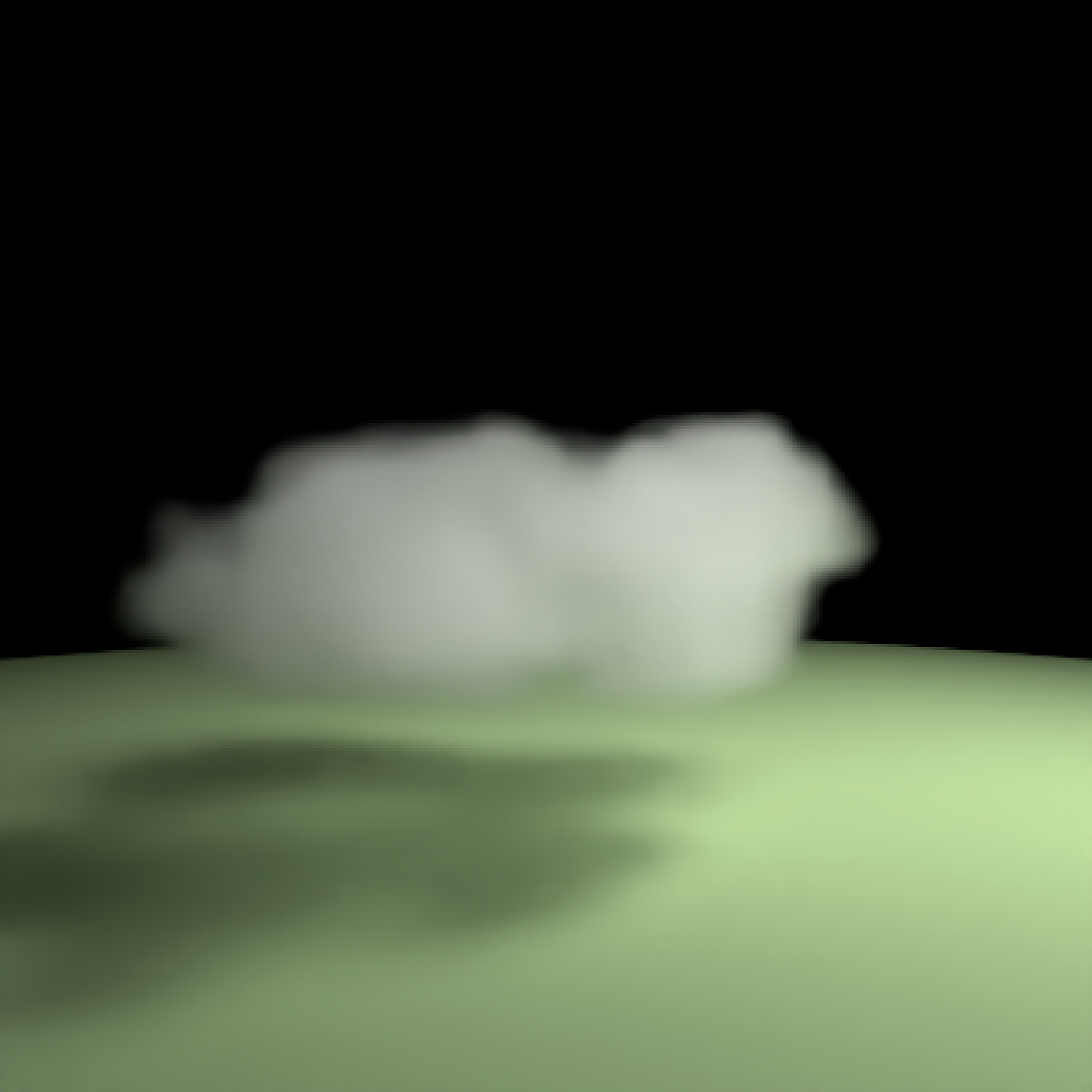
# The default cloud is centered at the origin. Raise a cloud by its center
# to put its base above the ground, then rotate the entire density field.
puff = cloud(y = 20, width = 60, height = 20, depth = 40,
angle = c(0, 25, 0), resolution = 64, optical_depth = 4)
scene = generate_ground(material = diffuse("#699447")) |>
add_object(puff) |>
add_object(sphere(x = -50, y = 80, z = -30, radius = 15,
material = light(intensity = 40)))
render_scene(scene, lookfrom = c(80, 35, -100), lookat = c(0, 20, 0),
fov = 35, integrator_type = "nee", samples = 64,
clamp_value = Inf, aperture = 0)
 # Reuse the shape at another position, or change the style and its detail.
bank = cloud(x = 0, y = w0, z = 6, style = "stratus", seed = 17,
width = 80, height = 10, depth = 50,
coverage = 0.7, detail = 0.2, optical_depth = 6, g = 0.6)
#> Error: object 'w0' not found
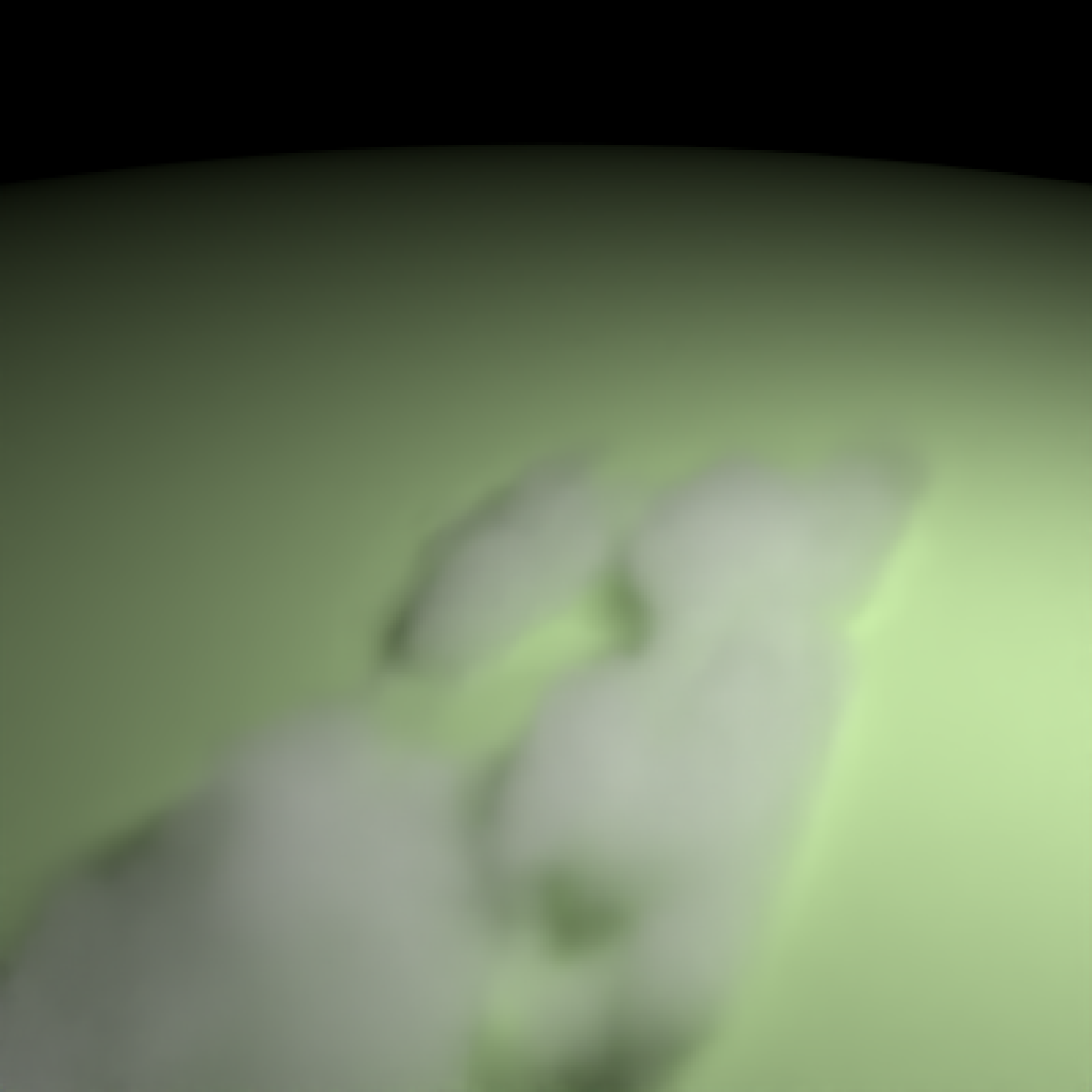
scaled = cloud(scale = c(1.5, 1, 0.75), angle = c(10, 30, 0),
order_rotation = c(2, 1, 3), resolution = 64)
generate_ground(material = diffuse("#699447")) |>
add_object(bank) |>
add_object(sphere(x = -50, y = 80, z = -30, radius = 15,
material = light(intensity = 40))) |>
render_scene(lookfrom = c(80, 100, -100), lookat = c(0, 20, 0),
fov = 35, integrator_type = "nee", samples = 64,
clamp_value = Inf, aperture = 0)
#> Error: object 'bank' not found
generate_ground(material = diffuse("#699447")) |>
add_object(scaled) |>
add_object(sphere(x = -50, y = 80, z = -30, radius = 15,
material = light(intensity = 40))) |>
render_scene(lookfrom = c(80, 100, -100), lookat = c(0, 20, 0),
fov = 35, integrator_type = "nee", samples = 64,
clamp_value = Inf, aperture = 0)
# Reuse the shape at another position, or change the style and its detail.
bank = cloud(x = 0, y = w0, z = 6, style = "stratus", seed = 17,
width = 80, height = 10, depth = 50,
coverage = 0.7, detail = 0.2, optical_depth = 6, g = 0.6)
#> Error: object 'w0' not found
scaled = cloud(scale = c(1.5, 1, 0.75), angle = c(10, 30, 0),
order_rotation = c(2, 1, 3), resolution = 64)
generate_ground(material = diffuse("#699447")) |>
add_object(bank) |>
add_object(sphere(x = -50, y = 80, z = -30, radius = 15,
material = light(intensity = 40))) |>
render_scene(lookfrom = c(80, 100, -100), lookat = c(0, 20, 0),
fov = 35, integrator_type = "nee", samples = 64,
clamp_value = Inf, aperture = 0)
#> Error: object 'bank' not found
generate_ground(material = diffuse("#699447")) |>
add_object(scaled) |>
add_object(sphere(x = -50, y = 80, z = -30, radius = 15,
material = light(intensity = 40))) |>
render_scene(lookfrom = c(80, 100, -100), lookat = c(0, 20, 0),
fov = 35, integrator_type = "nee", samples = 64,
clamp_value = Inf, aperture = 0)
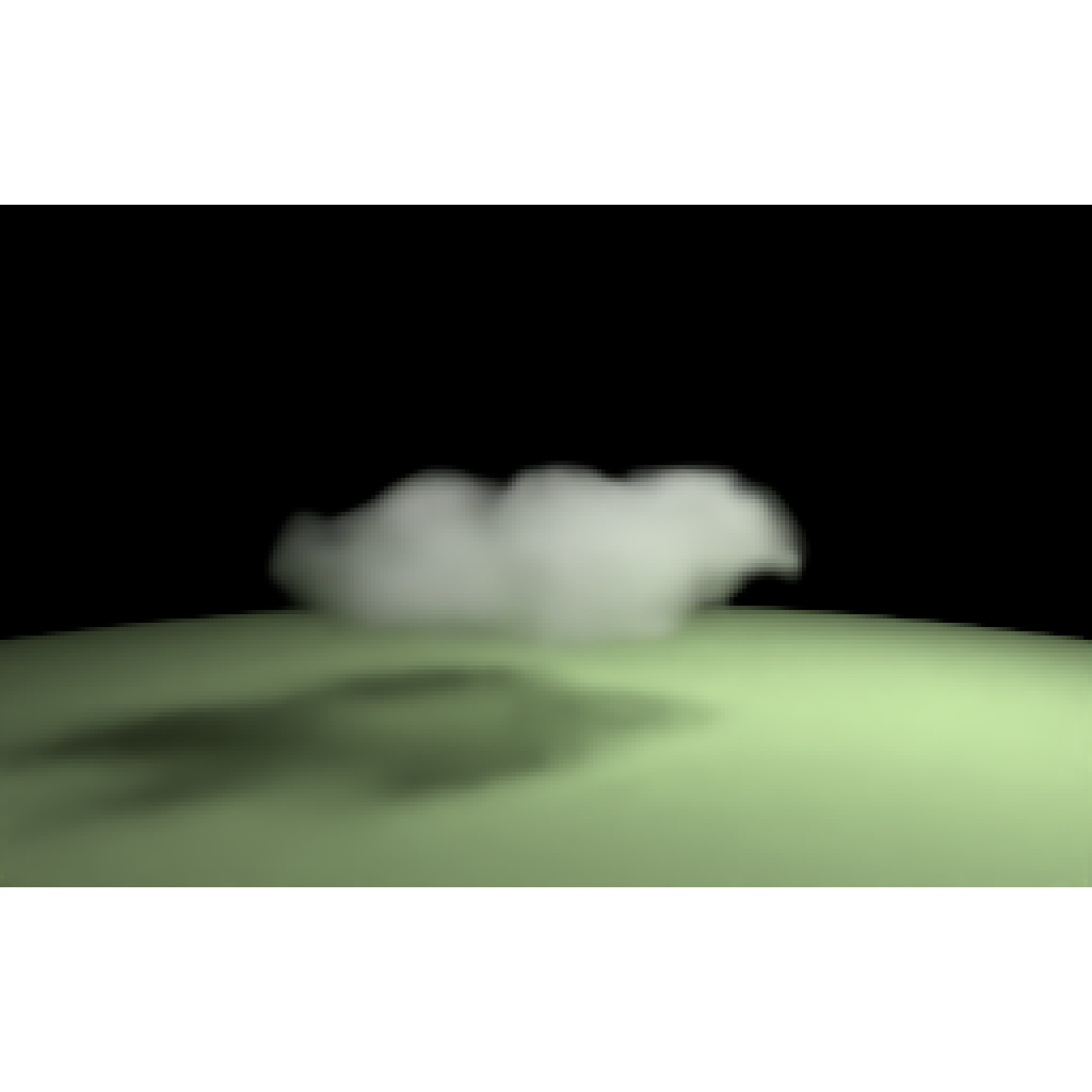
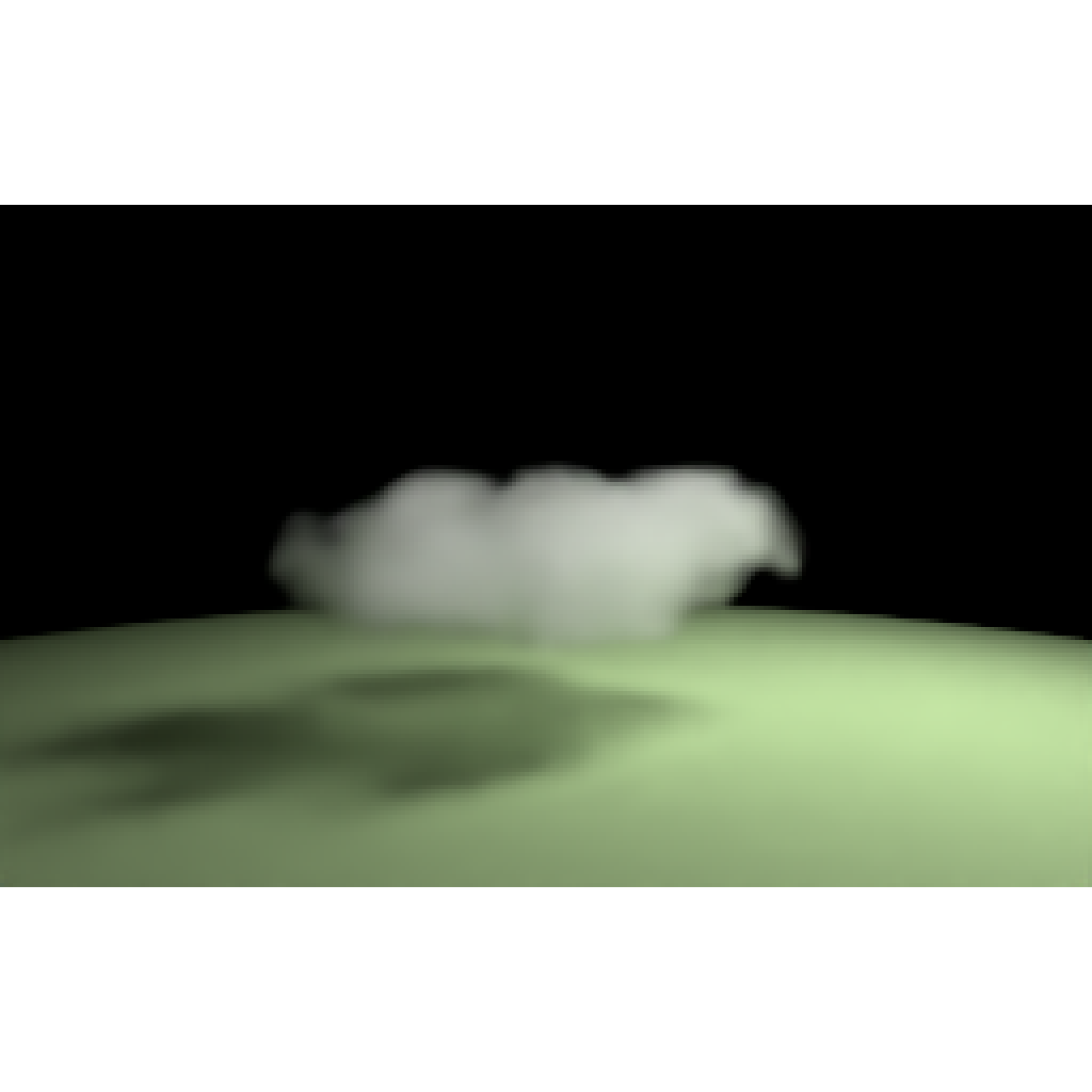
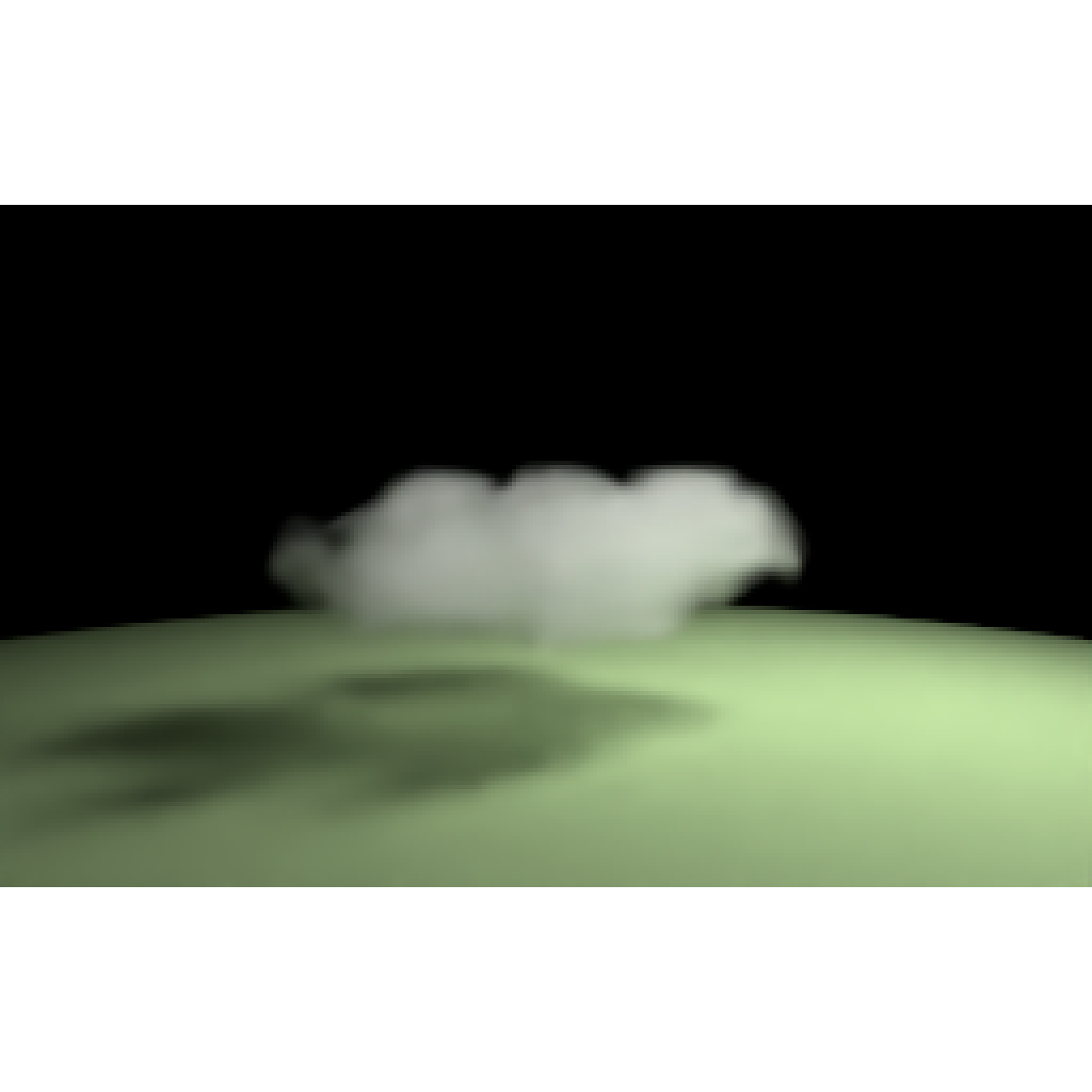
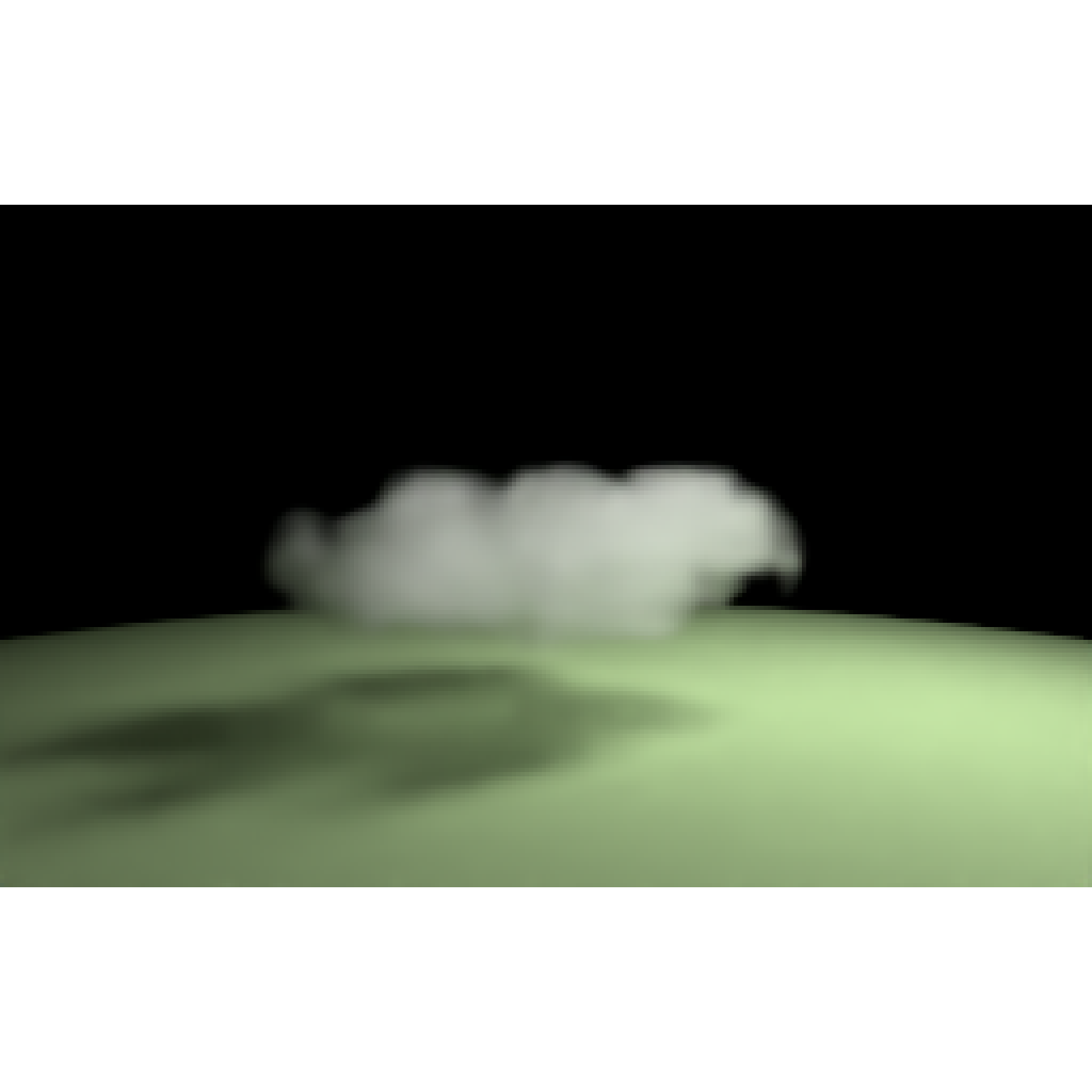
 # Keep seeds and position fixed to evolve the cloud locally over time.
# Rebuilding a frame at the same t value always gives the same cloud.
for (frame in 0:3) {
set.seed(2026)
generate_ground(material = diffuse("#699447")) |>
add_object(cloud(y = 20, width = 60, height = 20, depth = 40,
seed = 42, t = frame / 3, animation_seed = 17,
resolution = 64, optical_depth = 4)) |>
add_object(sphere(x = -50, y = 80, z = -30, radius = 15,
material = light(intensity = 40))) |>
render_scene(lookfrom = c(80, 35, -100), lookat = c(0, 20, 0),
width = 256, height = 160, fov = 35, integrator_type = "nee",
samples = 64, iso = 100, aperture = 0)
}
# Keep seeds and position fixed to evolve the cloud locally over time.
# Rebuilding a frame at the same t value always gives the same cloud.
for (frame in 0:3) {
set.seed(2026)
generate_ground(material = diffuse("#699447")) |>
add_object(cloud(y = 20, width = 60, height = 20, depth = 40,
seed = 42, t = frame / 3, animation_seed = 17,
resolution = 64, optical_depth = 4)) |>
add_object(sphere(x = -50, y = 80, z = -30, radius = 15,
material = light(intensity = 40))) |>
render_scene(lookfrom = c(80, 35, -100), lookat = c(0, 20, 0),
width = 256, height = 160, fov = 35, integrator_type = "nee",
samples = 64, iso = 100, aperture = 0)
}