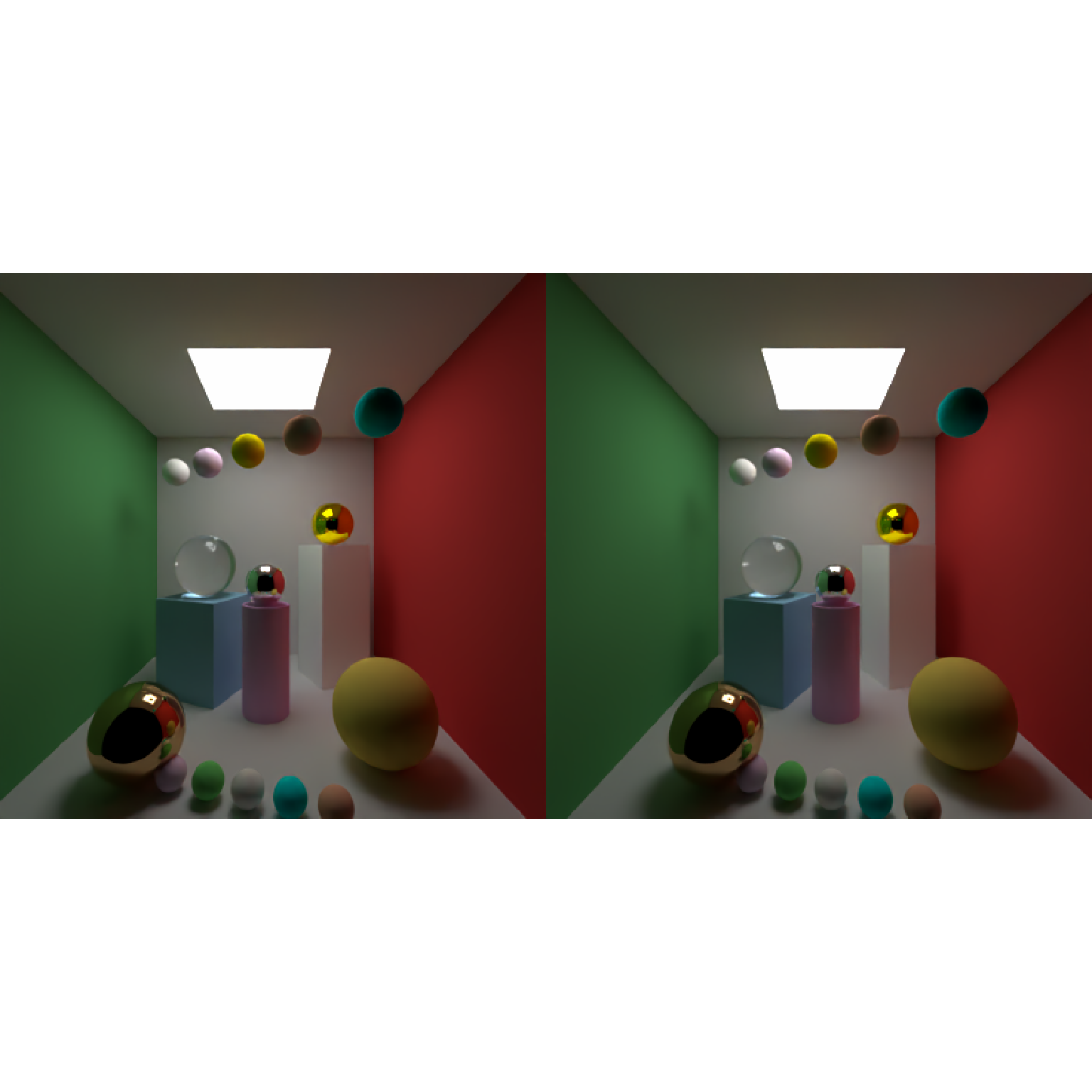
Adds a camera to a `ray_scene`.
add_camera(scene, camera, name = NULL, active = TRUE, replace = FALSE)Arguments
Value
A modified `ray_scene`.
Examples
scene = generate_ground(material=diffuse(color="grey20")) |>
add_object(sphere()) |>
add_camera(camera(
name = "main",
lookfrom = c(0, 1, -10),
lookat = c(0, 0, 0),
fov = 35
))
render_scene(scene, samples = 16)
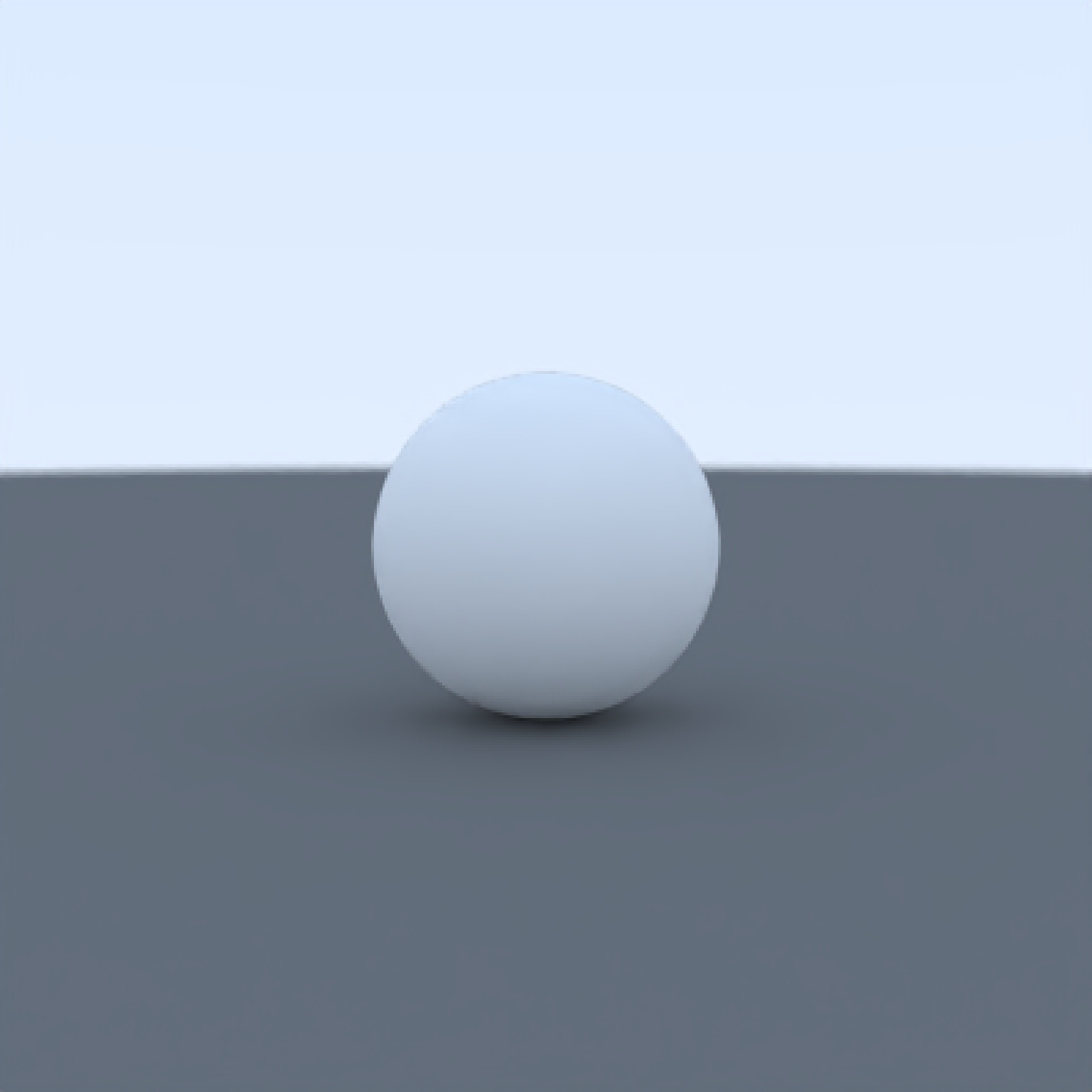 # Stereoscopic Cornell box: objects at different depths emphasize parallax.
stereo_scene = generate_cornell(lightwidth = 200, lightdepth = 200) |>
add_object(cube(
x = 130, y = 140, z = 420, scale = c(110, 280, 110),
angle = c(0, 20, 0), material = diffuse(color = "ivory")
)) |>
add_object(sphere(
x = 130, y = 325, z = 420, radius = 45,
material = metal(color = "gold")
)) |>
add_object(cube(
x = 390, y = 90, z = 360, scale = c(130, 180, 130),
angle = c(0, -25, 0), material = diffuse(color = "steelblue")
)) |>
add_object(sphere(
x = 390, y = 240, z = 360, radius = 60,
material = dielectric()
)) |>
add_object(cylinder(
x = 270, y = 90, z = 270, radius = 40, length = 180,
material = diffuse(color = "orchid")
)) |>
add_object(sphere(
x = 270, y = 215, z = 270, radius = 35,
material = metal()
)) |>
add_object(sphere(
x = 115, y = 65, z = 145, radius = 65,
material = diffuse(color = "goldenrod")
)) |>
add_object(sphere(
x = 420, y = 55, z = 115, radius = 55,
material = metal(color = "#B87333")
))
# Small foreground balls and suspended balls add more depth cues.
for (i in seq_len(5)) {
stereo_scene = stereo_scene |>
add_object(sphere(
x = 150 + 45 * i, y = 18, z = 35 + 12 * i, radius = 18,
material = diffuse(color = c("coral", "cyan", "ivory", "limegreen", "plum")[i])
)) |>
add_object(sphere(
x = 70 + 75 * i, y = 420, z = 70 * i, radius = 25,
material = diffuse(color = c("cyan", "coral", "gold", "plum", "ivory")[i])
))
}
# Looking into the box along +z, the viewer's left is the +x direction.
# Offset both lookfrom and lookat equally to keep the cameras parallel.
eye_separation = 40
stereo_scene_camera = stereo_scene |>
add_camera(camera(
name = "left_eye",
lookfrom = c(278 + eye_separation / 2, 278, -278),
lookat = c(278 + eye_separation / 2, 278, 278),
fov = 80, aperture = 0
)) |>
add_camera(camera(
name = "right_eye",
lookfrom = c(278 - eye_separation / 2, 278, -278),
lookat = c(278 - eye_separation / 2, 278, 278),
fov = 80, aperture = 0
))
left_image = render_scene(
stereo_scene_camera, camera = "left_eye", width = 400, height = 400,
samples = 16, ambient_light = FALSE, clamp_value = 10,
preview = FALSE, plot_scene = FALSE
)
right_image = render_scene(
stereo_scene_camera, camera = "right_eye", width = 400, height = 400,
samples = 16, ambient_light = FALSE, clamp_value = 10,
preview = FALSE, plot_scene = FALSE
)
# Parallel (non-cross-eyed) viewing: left eye image on the left.
# Look through the pair; display it small enough to fuse comfortably.
parallel_stereo = rayimage::render_stack(
list(left_image, right_image), stack = "horizontal", preview = TRUE
)
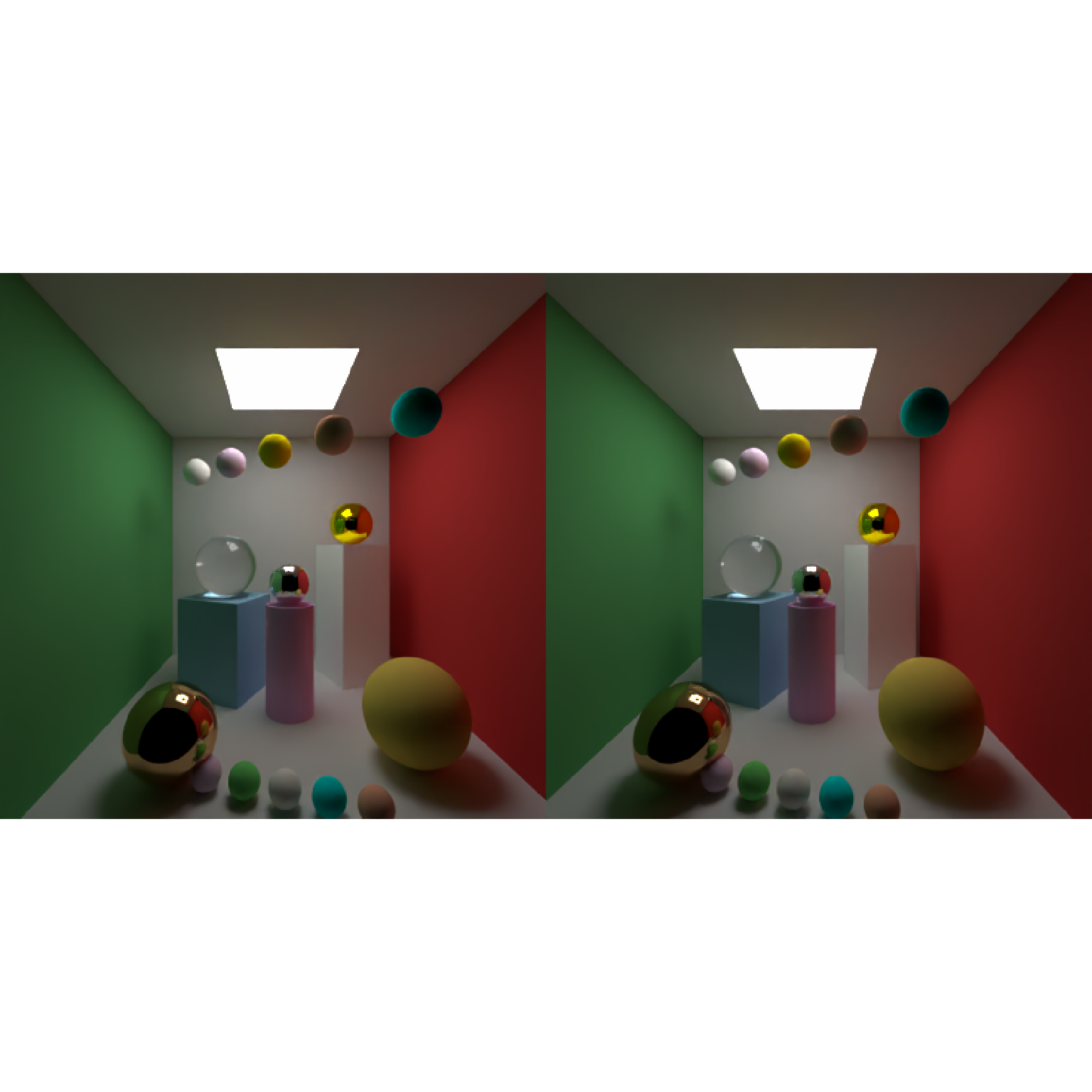 # Cross-eyed viewing: right eye image on the left.
# Cross your eyes until the two central images overlap.
cross_eyed_stereo = rayimage::render_stack(
list(right_image, left_image), stack = "horizontal", preview = TRUE
)