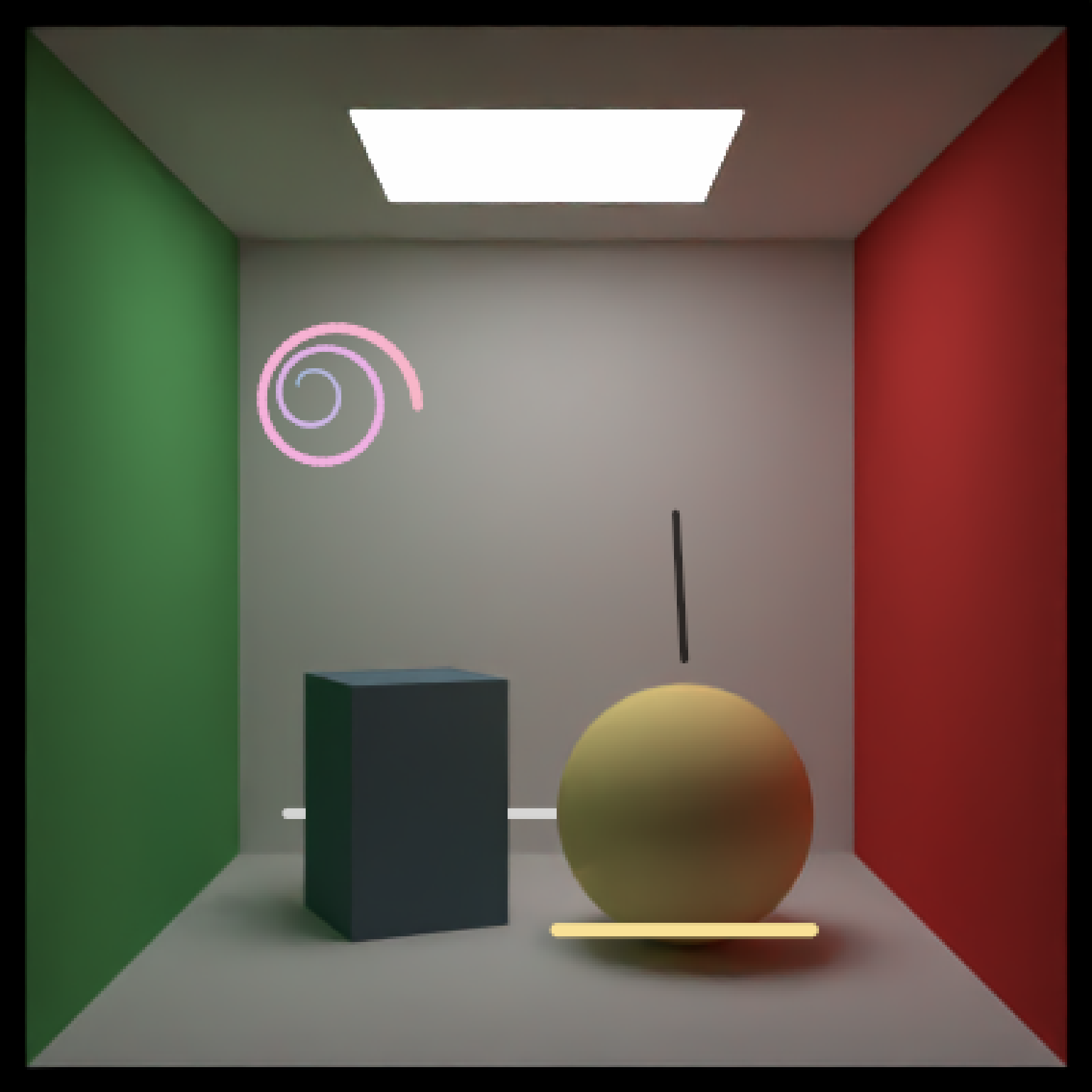
Creates line annotations for `render_scene()` that are anchored to 3D world-space endpoints but drawn in 2D screen space after rendering.
screen_line(
  x = 0,
  y = 0,
  z = 0,
  xend = 0,
  yend = 0,
  zend = 0,
  start = NULL,
  end = NULL,
  offset = c(0, 0),
  end_offset = offset,
  width = 2,
  color = "black",
  alpha = 1,
  lineend = "round",
  clip = TRUE,
  occlusion = FALSE,
  occlusion_mode = "anchor",
  occlusion_tolerance = 0.001
)
Arguments
- x, y, z
Default `0`. World-space coordinates of the line start point.
- xend, yend, zend
Default `0`. World-space coordinates of the line end point.
- start, end
Default `NULL`. Optional 3-column matrix/data frame of world-space start and end points. If supplied, overrides `x`, `y`, `z` and `xend`, `yend`, `zend`.
- offset
Default `c(0,0)`. Pixel offset for the start point, as `c(x,y)`, with positive y moving down the image.
- end_offset
Default `offset`. Pixel offset for the end point.
- width
Default `2`. Line width in pixels.
- color
Default `"black"`. Line color.
- alpha
Default `1`. Line alpha.
- lineend
Default `"round"`. Line end style. Options are `"round"`, `"butt"`, and `"square"`.
- clip
Default `TRUE`. If `TRUE`, lines whose endpoints are both behind the camera are skipped.
- occlusion
Default `FALSE`. If `TRUE`, use scene geometry to hide the line.
- occlusion_mode
Default `"anchor"`. If `"anchor"`, occlusion skips the entire line when its midpoint is blocked. If `"line"` or `"partial"`, each line pixel is hidden only when the scene depth at that pixel is closer than the interpolated screen-space line depth.
- occlusion_tolerance
Default `0.001`. Endpoint tolerance for occlusion.
Value
A data frame describing screen-space line annotations.
Examples
# Build the scene first, then add independent screen-space line layers.
scene = generate_cornell(lightwidth = 250, lightdepth = 250) |>
  add_object(sphere(
    x = 180, y = 90, z = 260, radius = 90,
    material = diffuse(color = "#f2c14e")
  )) |>
  add_object(cube(
    x = 385, y = 90, z = 330, xwidth = 120, ywidth = 180, zwidth = 120,
    angle = c(0, 25, 0), material = diffuse(color = "#243846")
  ))

# A round-ended measurement across the sphere uses matrix start/end points.
sphere_measure = screen_line(
  start = matrix(c(90, 6, 260), ncol = 3),
  end = matrix(c(270, 6, 260), ncol = 3),
  offset = c(0, 0),
  end_offset = c(0, 0),
  width = 5,
  color = "#f2c14e",
  alpha = 1,
  lineend = "round",
  clip = TRUE,
  occlusion = FALSE,
  occlusion_mode = "anchor",
  occlusion_tolerance = 0.001
)

# A vertical guide on the rotated box exercises line-level occlusion.
box_measure = screen_line(
  start = matrix(c(385, 0, 330), ncol = 3),
  end = matrix(c(385, 180, 330), ncol = 3),
  offset = c(-12, 0),
  end_offset = c(-12, 0),
  width = 7,
  color = "#4d9de0",
  alpha = 0.8,
  lineend = "butt",
  clip = TRUE,
  occlusion = TRUE,
  occlusion_mode = "line",
  occlusion_tolerance = 0.004
)

# A back-wall rule uses square caps, no clipping, and the "partial" alias.
wall_rule = screen_line(
  start = matrix(c(85, 18, 545), ncol = 3),
  end = matrix(c(505, 18, 545), ncol = 3),
  offset = c(0, -8),
  end_offset = c(0, -8),
  width = 4,
  color = "white",
  alpha = 0.6,
  lineend = "square",
  clip = FALSE,
  occlusion = TRUE,
  occlusion_mode = "partial",
  occlusion_tolerance = 0.01
)

# Scalar coordinates work too, which is handy for one-off callout lines.
callout_line = screen_line(
  x = 180, y = 190, z = 260,
  xend = 245, yend = 255, zend = 230,
  offset = c(0, -4),
  end_offset = c(30, -24),
  width = 3,
  color = "black",
  alpha = 0.9,
  lineend = "round",
  clip = TRUE,
  occlusion = TRUE,
  occlusion_mode = "anchor",
  occlusion_tolerance = 0.002
)

# Build a 3D spiral from many short screen-space line segments.
spiral_theta = seq(0, 5 * pi, length.out = 120)
spiral_radius = seq(6, 65, length.out = length(spiral_theta))
spiral_points = cbind(
  445 + spiral_radius * cos(spiral_theta),
  390 + spiral_radius * sin(spiral_theta),
  seq(245, 390, length.out = length(spiral_theta))
)
spiral_count = nrow(spiral_points) - 1
spiral_lines = screen_line(
  start = spiral_points[-nrow(spiral_points), ],
  end = spiral_points[-1, ],
  width = seq(1, 4, length.out = spiral_count),
  color = grDevices::hcl(seq(250, 360, length.out = spiral_count), 80, 65),
  alpha = seq(0.35, 0.95, length.out = spiral_count),
  lineend = "round",
  clip = TRUE
)

line_layers = list(
  sphere_measure,
  box_measure,
  wall_rule,
  callout_line,
  spiral_lines
)

render_scene(
  scene,
  samples = 32,
  clamp_value = 5,
  aperture = 0,
  ambient_light = FALSE,
  screen_line = line_layers
)
#> Setting default values for Cornell box: lookfrom `c(278,278,-800)` lookat `c(278,278,555/2)` fov `40` .